Bedroom Curtain Ideas: A Designer's Guide to Getting Them Right
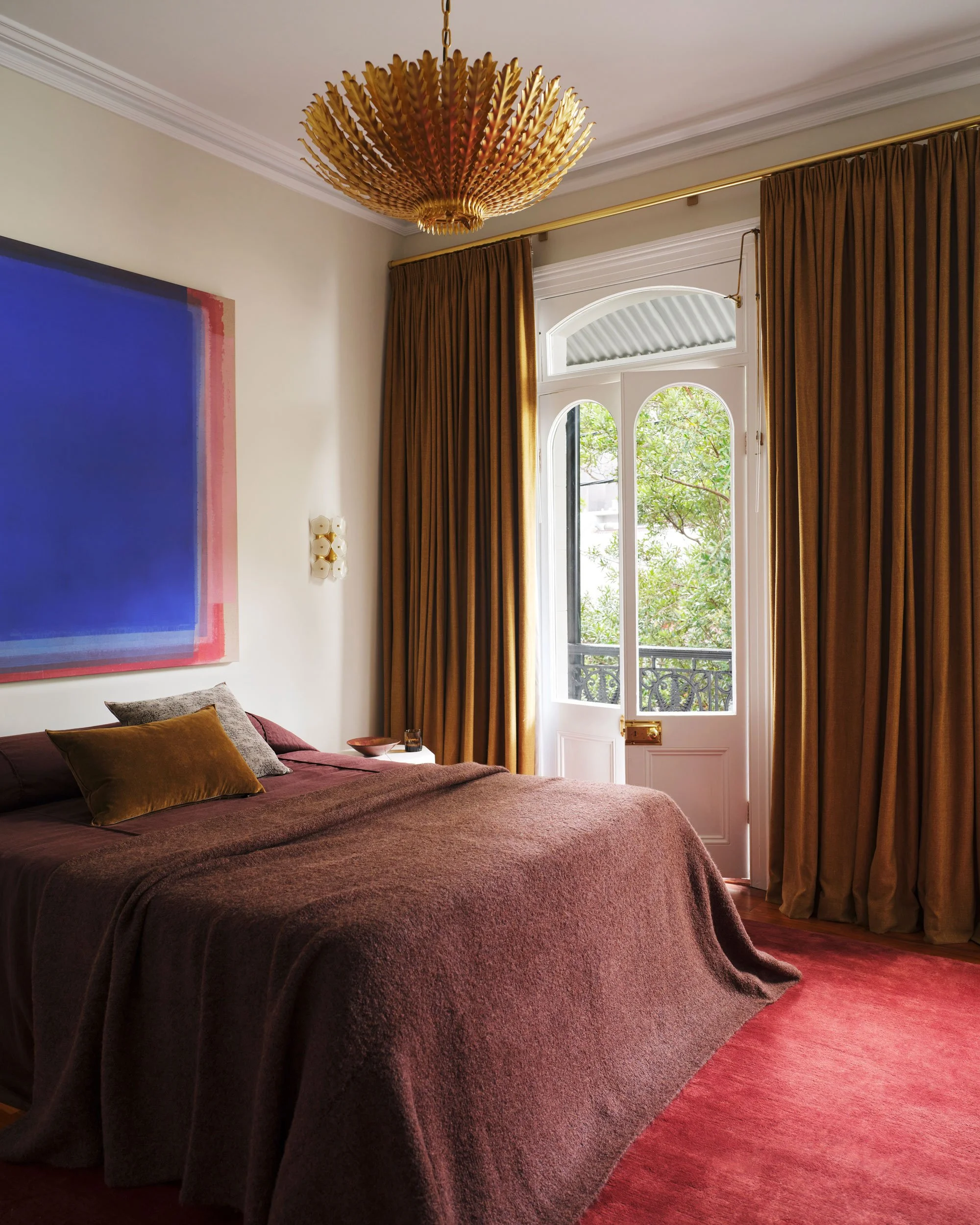
KAIKO DESIGN INTERIORS - CHIPPENDALE TERRACE HOUSE, LUXE DRAPERY
The bedroom is the hardest room to dress well. That sounds counterintuitive — it's a single room with a single window, usually without the spatial complexity of an open-plan living area. But the brief is more demanding than it appears.
In every other room, curtains are managing light. In the bedroom, they're managing light and privacy and proportion and the relationship to a room already saturated with soft furnishings. The fabric is living alongside a bed, a headboard, bedding, cushions, and sometimes a rug. It needs to work at 11pm and at 6am. It needs to perform visually when the bed is made and be functionally invisible when you're trying to sleep.
Get it wrong and you've spent a significant amount of money on something that fights the room at every turn. The bedroom curtain ideas that work aren't trend-driven — they come from understanding the specification requirements first.
At Kaiko Design, this is where every brief starts.
Why the Bedroom Brief Is More Demanding
Most rooms ask curtains to filter light and frame the window. The bedroom asks more: complete darkness on demand, genuine privacy, the ability to make a room feel taller than it is, and visual harmony with the dominant textile — the bed.
Add the Australian light context and the brief sharpens further. Sydney bedrooms with eastern or northern exposures deal with early, intense morning light that most European-designed curtaining systems weren't calibrated for. The assumption that a standard lining will "do the job" is where most off-the-shelf solutions fall short.
Track or Rod — The Decision That Shapes Everything Else
This is the first specification decision, and it determines what's possible downstream.
Curtain tracks — ceiling-mounted or recessed behind a pelmet — are the default choice in most of the bedrooms we work on at Kaiko Design. The reasons are technical, not aesthetic. A track with a return (a curve at each end that brings the curtain back to the wall) eliminates the light gap that opens at the sides of a window when a standard blackout curtain is drawn. For east-facing Sydney bedrooms, that side gap isn't a minor inconvenience — it defeats the purpose of the blackout entirely. Tracks also handle the weight of lined and interlined drapes more cleanly than rods over wider spans, with no centre bracket interfering with the curtain's travel.
Curtain rods earn their place when hardware is part of the design intent. A brass or matte black rod with considered finials adds a layer of material detail that tracks, by definition, cannot provide. They work particularly well in rooms where the window treatment is a deliberate design accent rather than a functional system that should disappear. The trade-off is precision: without a return, complete blackout requires additional engineering — a reveal-mounted blind behind the curtain, or a deep pelmet box above.
Double-track systems — two parallel tracks at the same header — allow a sheer inner layer and a blackout outer layer to operate independently. This is our recommended specification for most master bedrooms. It gives the occupant full control: sheers alone for diffused morning light, full blackout for deep sleep, or both drawn for complete privacy with maximum acoustic benefit.
You can read more about the broader light control considerations in our guide to choosing curtains for optimum light control.
Height and Drop — Ceiling Height Starts at the Header
Floor-to-ceiling curtains are almost always the right answer in a bedroom. The visual logic is simple: hanging a curtain from ceiling height to floor height makes the room feel taller. Hanging it from 20cm above the window frame — as builders' provisions typically suggest — makes the ceiling feel lower and the window feel smaller.
The key word is ceiling height, not window height. The rod or track should be fixed as close to the ceiling cornice as the room allows, or recessed into the ceiling itself. The curtain then drops to the floor. In rooms with high ceilings, a small break or deliberate puddle at the floor reads as intentional and relaxed. In rooms with standard 2.7m ceilings, curtains that graze the floor cleanly are preferable — a puddle on standard ceiling heights can read as miscalculation rather than design.
The exception for sill-length curtains is narrow: a deep windowseat beneath a window, or a very specific brief where the room's proportions call for it. In most residential bedrooms in Sydney, the floor-to-ceiling specification wins every time.
Lining — Where the Specification Actually Gets Made
Lining choice has more impact on performance than the face fabric, and it's the decision most clients underinvest in.
The lining hierarchy in brief:
Standard cotton lining adds body, protects the face fabric from UV degradation, and provides a degree of insulation. It's not sufficient for bedroom blackout in a Sydney home.
Blackout lining uses a three-pass acrylic or silicone coating that blocks light penetration entirely. The coated side faces the glass. It adds weight and structure — both useful in a curtain that needs to hang well across a wide span. The common misconception is that blackout lining is black; most are ivory or cream on both faces. The coated surface is what does the work.
Thermal lining operates on the same principles but is calibrated for insulation — trapping air against the glass in winter, reflecting heat away in summer. In a Sydney climate, thermal performance is meaningful for west-facing bedrooms dealing with intense afternoon heat. Closing curtains during peak afternoon hours can measurably reduce the heat load in those rooms.
Interlining is a separate layer sewn between the face fabric and the lining — not a lining itself, but an addition to one. It adds weight, acoustic absorption, and a fullness that transforms how lightweight fabrics behave. A voile that would otherwise look thin and insubstantial drapes beautifully with interlining behind it. A linen panel gains a body it wouldn't otherwise have. At Kaiko Design, interlining is a regular specification in bedrooms where the face fabric is inherently light — which, in warmer climates, is most of them.
Fabric Weight and the Soft Furnishing Context
The bedroom is the one room in the house where the curtain is sharing visual territory with a concentration of textiles. The bed, the headboard, the bedding, any upholstered chair or ottoman — the room is already rich with fabric. The curtain specification has to be calibrated against that existing density, not chosen in isolation.
In most Sydney homes, this points toward natural fibres and lighter-weight fabrics for the face cloth: linen, linen blends, cotton, or cotton-linen combinations. These breathe in warmer climates, drape beautifully with the right interlining behind them, and sit comfortably alongside bedding rather than fighting it for visual dominance.
Heavier fabrics — velvet, chenille, woven jacquards — have their place in bedrooms with specific design briefs: high-contrast, colour-saturated schemes where the curtain is intended to be a feature; or cooler climates and rooms where thermal mass is a genuine priority. The risk in a warm climate is that a heavy velvet drape feels suffocating rather than luxurious. The right fabric read in a Sydney bedroom is generosity of drop and fullness of drape, not density of cloth.
For a comprehensive overview of how fabric choice affects room ambiance, our guide to fabric materials for window treatments covers the technical ground in depth.
Pattern, Scale, and Proportion
Pattern in bedroom curtains is a calibration exercise. The rule of thumb is simple: the larger the room volume, the more pattern can carry. In a modest bedroom, a large-scale repeat competes with every other textile in the room and usually loses. In a generous master suite with high ceilings, a bold botanical or geometric print can anchor the space in a way that plain fabric cannot.
In smaller rooms, vertical patterns — stripe or elongated geometric — reinforce the floor-to-ceiling specification, drawing the eye up. A tonal-on-tonal texture reads as calm and sophisticated without the visual noise of a printed repeat. If the bedding or headboard carries pattern, the curtain is usually better served by a considered plain: a colour pulled from the pattern rather than a competing print.
The relationship between bedroom wallpaper and curtain fabric is worth its own attention. This article sits alongside our guide to bedroom wallpaper selection — the two decisions are closely connected and often specified together.
The Questions to Ask Before You Specify
Before settling on a fabric, a header treatment, or a track system, these are the questions a designer will work through:
Which way does the window face? East-facing means early, direct sun. North-facing means consistent, bright light. West-facing means heat load in the afternoon. This determines the weight and opacity of lining required more than any other single variable.
What is the priority — blackout or ambiance? Some bedrooms need total darkness. Others need flexible control. A double-track system with sheer and blackout panels answers both. A single panel with blackout lining answers only one.
What is the ceiling height and does the window treatment need to compensate? The lower the ceiling, the more critical the floor-to-ceiling specification becomes.
What is already in the room texturally? Heavy bedding, a statement headboard, and a patterned rug narrow the curtain brief considerably. A plain white room opens it.
Is the hardware visible as a design element or does it need to disappear? Rod for the former. Ceiling track for the latter.
These questions are the starting point of every window treatment specification at Kaiko Design's residential interior design projects. Getting clear on function before making decisions about fabric and hardware is what separates a considered result from an expensive regret.
If you're working through a bedroom brief — or a wider project — a discovery call with the studio is the best first step.